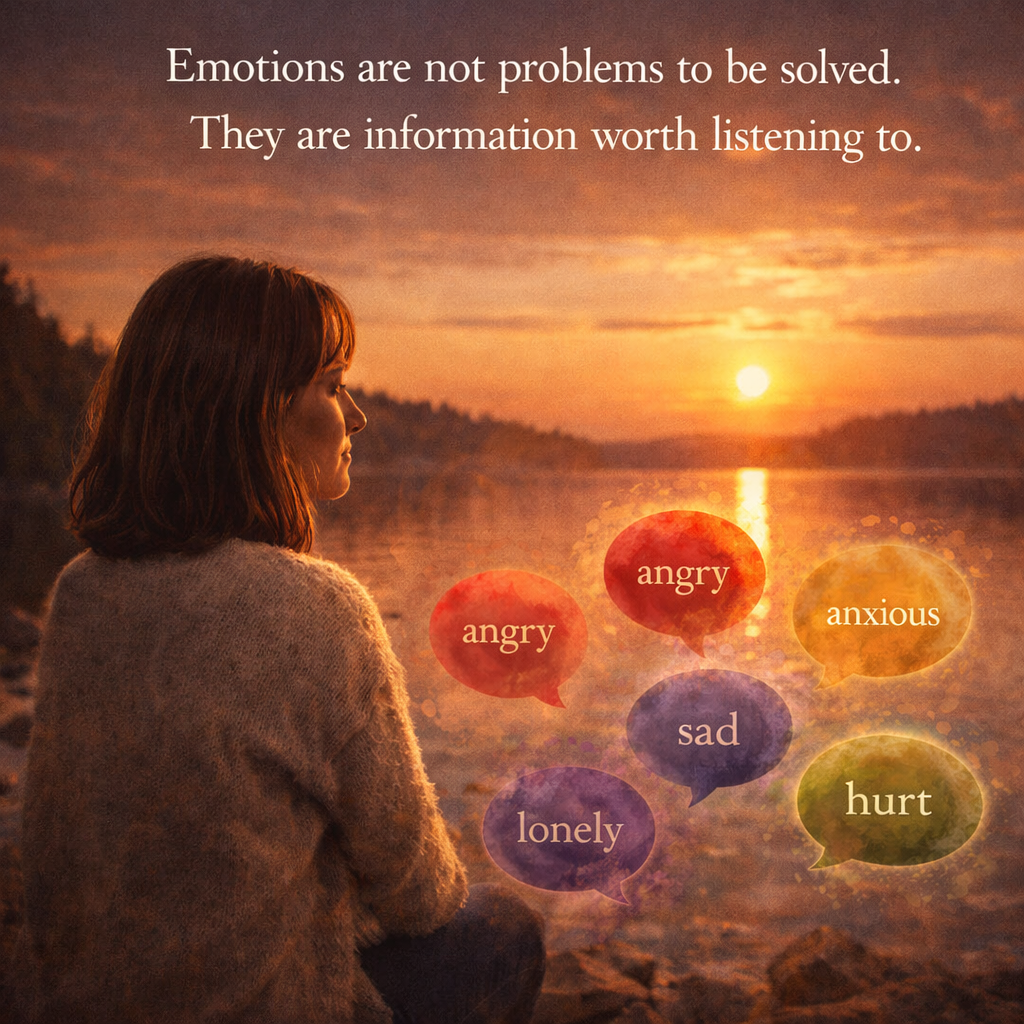
What do you do when a feeling arrives that you would rather not have?
For most people, the answer involves some version of management. Push it down, reason your way out of it, distract yourself until it passes, or simply keep moving and hope it doesn’t catch up. These are understandable responses — and in the short term, they often work well enough. The difficulty is what tends to happen over time.
There is a pervasive cultural assumption that emotional intensity is, at best, inconvenient and, at worst, a sign that something has gone wrong. Anxiety is treated as a malfunction. Anger is treated as a loss of control. Sadness is treated as something to be moved through as quickly as possible. The implicit message in much of how we talk about feelings is that the goal is to have fewer of them, or at least quieter ones.
This assumption is worth examining, because it is not well supported by what we actually understand about how emotions function.
Emotions are not arbitrary. They are, at their core, adaptive signals — rapid appraisals of a situation that prepare the body and mind to respond. Fear orients us toward threat. Anger signals a boundary that has been crossed or a value that is under pressure. Sadness slows us down and draws us inward, often in the wake of loss, prompting a kind of recalibration. Guilt signals a misalignment between our behaviour and our values. Even anxiety, for all the discomfort it carries, is the nervous system doing its job — alerting us to something that feels unresolved or uncertain.
This is the functional view of emotion, and it has substantial support in both evolutionary and clinical research. The point is not that every emotional response is accurate or proportionate — it isn’t always. The point is that emotions are trying to communicate something, and treating them primarily as problems to be eliminated tends to interrupt that communication before it has been understood.
What tends to happen when we consistently try to suppress or escape difficult feelings is described well within acceptance and commitment frameworks: avoidance amplifies. The more energy directed toward not feeling something, the more present that something tends to become. This is not a character flaw or a failure of willpower. It is a fairly predictable feature of how the mind works — what we resist, we attend to; what we attend to, we amplify. The emotional avoidance cycle is self-reinforcing precisely because the short-term relief it offers feels like evidence that the strategy is working, even as the longer-term cost accumulates quietly.
None of this means sitting passively inside every feeling that arises, or treating emotional expression as an end in itself. It means something more specific: approaching an emotion with enough curiosity to ask what it might be signalling, before moving to manage or eliminate it. What is this feeling pointing to? What does it seem to be asking for? Not every question will have a clear answer. But the act of asking shifts the relationship from one of opposition to one of inquiry, and that shift tends to reduce intensity rather than increase it.
The feelings that tend to cause the most difficulty are rarely the ones we allow ourselves to experience fully. They are the ones that have been partially felt, repeatedly interrupted, and never quite resolved. Giving an emotion enough space to be present — even briefly, even uncomfortably — is usually what allows it to move.
Feelings are not the enemy. They are, more often than not, the part of you that is paying attention.
Reflection: Think of a feeling you have been trying to manage or move past recently. Without needing to resolve it, is there anything it might be trying to tell you?